CASE STUDY
How a Fire Protection Company Found $300K Inside Its Own Contracts and Books
Issy · AI Orchestrator (with insights and guidance from the leadership team)
“This all started wanting to enhance our engineer and team experience, and bring AI into our business. Working with the Aspiro team to clarify and reconcile our data has been engaging, and the results will pay multiples of what we invested in the first place.”
— Rob H., Simpro and systems integration lead, fire safety and monitoring company
How it started
The way most of our engagements start: a curious discovery call, a specific request to train the team, and a four-hour AI fundamentals workshop to do it. What AI can do, what it should not, how to find the uses that actually fit your business, and enough hands-on that people leave thinking for themselves.
A month later the company came back with a specific idea. They wanted an app their inspectors could use on site, during the assessment, with the customer standing right there. The goal was to cut assessment turnaround from weeks to hours.
So we scoped it, and we are building it. Instead of field notes that become a report a week or two later, the inspector works in a clean app, captures what is needed while they are still in the building, and the report goes out in a fraction of the time. For a company that competes on service, and carries the liability during every day of the gap, that is a real wedge.
The timing helped. The company was moving its field and quoting work off a small-business tool and onto a full service management platform. Our app connects to that platform through its API, so the platform does the system-of-record work while the inspectors get an experience built around how they actually operate on site.
The app was only ever as good as the data behind it
Which is where the real work started.
The first challenge was practical: years of agreements living on a local NAS drive. We set up local ingestion, which is our standard. We do not want to hold a client's data, and if we can save them the $4,000 to $5,000 a month it costs to rent infrastructure they do not need, we do.
We ingest what we are legally clear to use and nothing else. With no mandate to touch HR files, we left them alone and stayed on the commercial record: the agreements themselves, more than a thousand active service contracts, the corresponding orders in the field platform, and the financials extracted from the accounting system.
Then we reconciled. Contract against the work performed. Work against the invoice. Invoice against the cash that actually came in.
That reconciliation matters because the record drifts, and it drifts invisibly. Every contract carries pricing, scope, escalation clauses, renewal terms, and obligations tied to inspection and maintenance intervals. Contracts get signed, filed, and then re-typed by hand into the field platform, the CRM, and the books. Pricing changes do not carry through. Scope changes get lost between versions. Deficiencies get written up and stall. The billing system says one thing and the signed agreement says another.
Nobody was checking. Not through negligence, because there had never been a moment that required it. So we built a pipeline that checks and flags anything that does not line up.
What we found
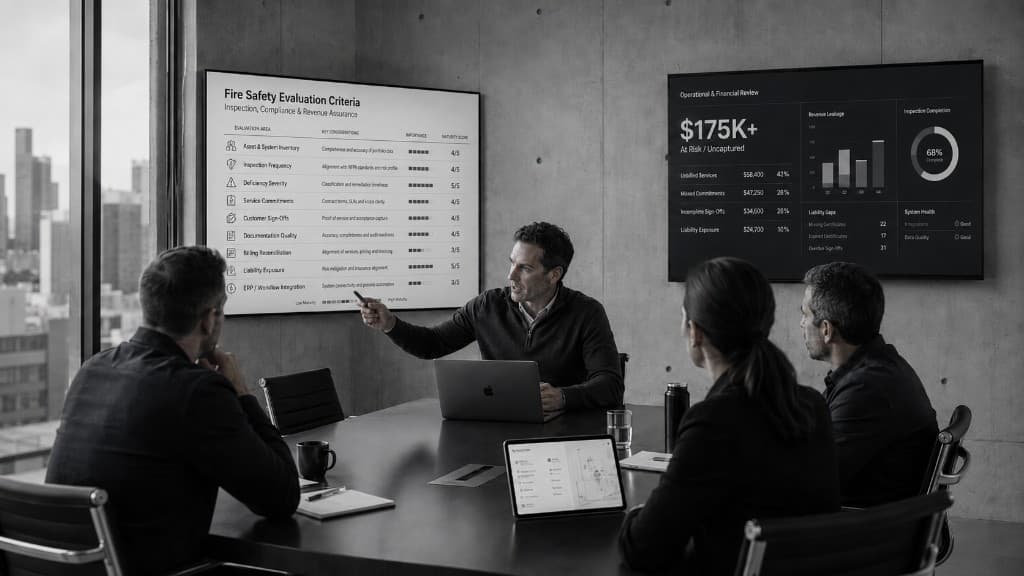
More than $300,000, in two forms.
Work that was agreed, performed, and never billed. A meaningful portion of it recoverable.
Services being invoiced with no contract on file. When there is no agreement in the system, the annual assessments that agreement is supposed to trigger can slip their schedule and go unbilled. The revenue leak and the compliance gap are the same event.
Underneath that sat something the totals do not capture: work that was contracted and never performed.
In this industry that is the bigger exposure by a wide margin. When an agreement says an inspection will happen and it does not, a building is not protected the way its owner believes it is. In a claim, that lands on the service company and its insurers, and the fines and liability can run into the millions. No line on a P&L shows it. It surfaces once, at the worst possible moment.
The books had also never fully reconciled year over year. Nobody had audited why. This is what why looked like.
What it exposed beyond the numbers
Two things worth naming, because they are common.
Institutional memory lived in people's heads. Much of the operating history of the business sat with a small number of people rather than in any system. Which contract covers which building, what was verbally agreed years earlier, why that customer gets that rate. That works until those people leave, get busy, or disagree. A clean, shared source of truth is the only real protection, and most owner-led businesses of this size do not have one.
Clean data changed what the commercial team wanted. Once the record was trustworthy, the sales leads got interested rather than defensive, and started asking for tools to help their field people keep the CRM and their follow-ups current. Adoption problems in these businesses are often data-trust problems first.
How it was structured
We ran this on a retainer plus a success fee against what we recovered. We structure a mandate that way when the scope is clear, the business is large enough to matter, and aligning the incentives is better for both sides than a flat quote nobody can size.
Where it stands:
- The company funded a real AI development budget out of the money the work found.
- The books are substantially closer to reconciling.
- A proper source-of-truth database is in place and ready to build on.
- The agreements are being filed and structured correctly for the first time.
The found revenue is what makes the deeper work possible. That is the whole sequence: prove the return, then spend the return on the foundations, so at every stage the business knows exactly what it got for the money.
Alongside it we run an ongoing oversight service we call the eye in the sky, watching data integrity, system outputs, and how the tools are actually being used. That is the part that matters most and gets discussed least. A one-time reconciliation is a snapshot. Continuous oversight is what stops the same gaps quietly reopening over the following eighteen months.
Where we fit into the ecosystem
We do not replace your field platform. Simpro, BuildOps, ServiceTrade, InspectPoint, Jobber: these are good systems. Stay on them. We layer on top and connect through their APIs.
We complement your implementation partner. They are getting you onto the platform. We deal with what the migration exposes, the difference between what your systems say and where the gaps actually are, which is a different problem and generally outside their scope.
We do not replace your IT lead or your internal AI person, if you have one. They usually become our key contact on this work, and when we are done, their work should be easier to implement.
We sit across the seams because the seams are where the money, the risk, and the misdiagnosed people problems live. Owning the seams is generally not in anyone's job description, and even when audits find those issues, fixing them can be a challenge.
What it was worth
The $300,000 found. Plus the opportunity cost that no longer repeats every year. Plus the liability and fine exposure that could have run into seven figures.
The return on this kind of mandate is visible and countable, and that clarity is the actual lesson. Start with the clear wins and the clear risks. Prove the return. Then use it to fund what the business genuinely needs.
We wrote up the specific lessons from this engagement separately, here. If you run a fire protection or inspection company and want to see how we approach this kind of work, start here.