FIRE PROTECTION · NEW YORK CITY
AI for fire protection companies in New York City
YOUR JOURNEY
Coaching → Workshops → Sprint → AI Department → Innovation Lab
New York City is the hardest place in the country to run a fire protection company and keep the paperwork straight. Between FDNY, the Department of Buildings, high-rise stock, and thousands of assets per building, the work moves faster than the systems tracking it. We help NYC operators connect the systems they already run so the work their crews did actually gets billed.
← AI for fire protection and inspection companies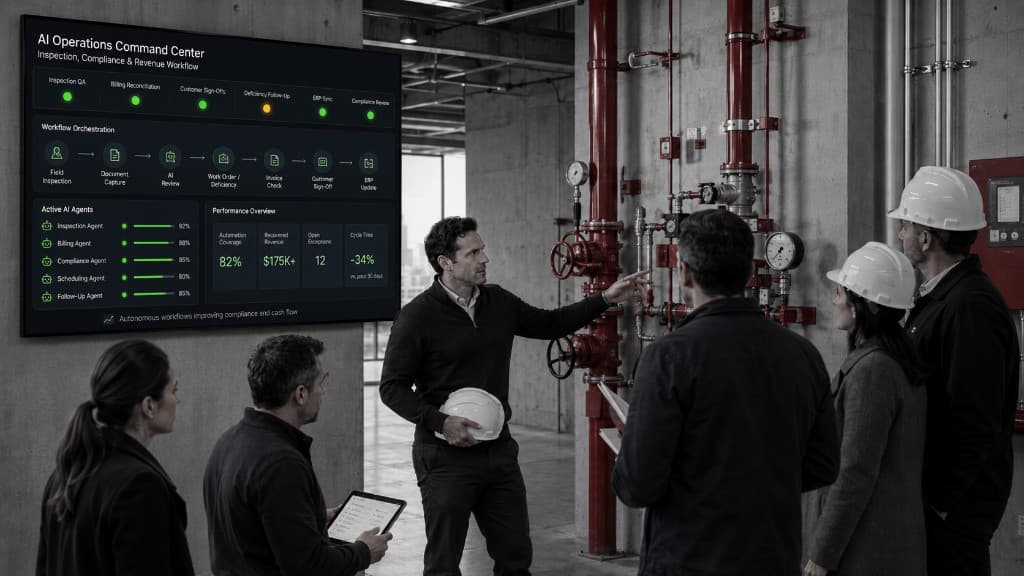
What NYC fire protection companies deal with
In the five boroughs you answer to two masters. FDNY handles fire safety enforcement, inspections, and the licenses and Certificates of Fitness your people carry. The Department of Buildings handles the building code and construction permits. Sprinkler and standpipe work runs through licensed fire suppression contractors and FDNY filings, and high-rise and assembly buildings pile requirements on top of the NFPA 25, 72 and 10 baseline.
That means more filings, more inspection frequencies, and more deficiency records per account than almost anywhere else. When that volume runs through a field platform, a separate CRM, and an accounting system that do not talk to each other, things fall through the cracks fast.
- FDNY enforcement and Certificates of Fitness for your techs
- DOB permits and filings on the construction side
- Licensed fire suppression contractor rules for sprinkler and standpipe work
- High-rise and assembly occupancy requirements on top of NFPA
Where the money leaks in a NYC book
The pattern is the same as everywhere, just at higher volume. A crew finishes a job in a Midtown high-rise, writes up three deficiencies, and none of them turn into a quote. A contract escalates every year and the invoice never catches up. An account in Brooklyn renews on an equipment list that has been wrong since 2023. Multiply that across hundreds of buildings and it is real money.
We ran this exact reconciliation for a fire safety and monitoring company. Reading the contracts against the work actually done, then the invoices, then the cash, we found over $300,000 in work that was billed wrong, never billed, or done with no contract on file. That figure did not even count the work that was agreed to and never done, which is a liability problem all on its own.
What we do
We start with an alignment Sprint or CEO coaching, sit down with your people, and find where the money leaks before we touch anything. Then we connect the systems you already run, whether that is Simpro, Jobber, ServiceTrade or FieldEdge on the field side and QuickBooks or an ERP on the money side, and put AI on top so the contract, the field work, the invoice and the CRM finally tell the same story.
We have also built tools that help inspectors turn out faster, cleaner reports on site, with fewer callbacks, and tie those reports to the equipment that needs supply or renewal. In a market with FDNY filing deadlines and packed schedules, getting the report right the first time is worth real money.
RELATED CASE STUDY
We read a fire safety and monitoring company's contracts against the work done, the invoices, and the cash. Here is what we found.
How we found over $300K in a fire safety and monitoring company's contracts and books →RELATED INSIGHTS
FREQUENTLY ASKED
- Do you handle FDNY or DOB filings for us?
- No. We do not file with FDNY or DOB and we do not perform regulated inspections. We make sure your own data lines up with what those filings, your contracts, and your customers require, so nothing gets missed and nothing gets double-handled.
- Do you replace ServiceTrade, Simpro or our accounting system?
- No. You keep your systems. We connect them so the work, the contract, the invoice and the CRM match. Replacing a platform in the middle of a busy NYC book is usually the wrong first move.
- We work the boroughs plus Long Island and Westchester. Does that matter?
- Only in the sense that more jurisdictions mean more filings and more chances for the data to drift. That is exactly the problem we solve. The approach is the same whether you work Manhattan, the outer boroughs, Nassau and Suffolk, or up into Westchester.
- What does it cost to start?
- A $15,000 alignment Sprint, or CEO coaching if the leadership conversation comes first. We get aligned, rank your best use cases, and pick the first fix worth doing. The ingestion and reconciliation work gets scoped after we see your contracts and systems.